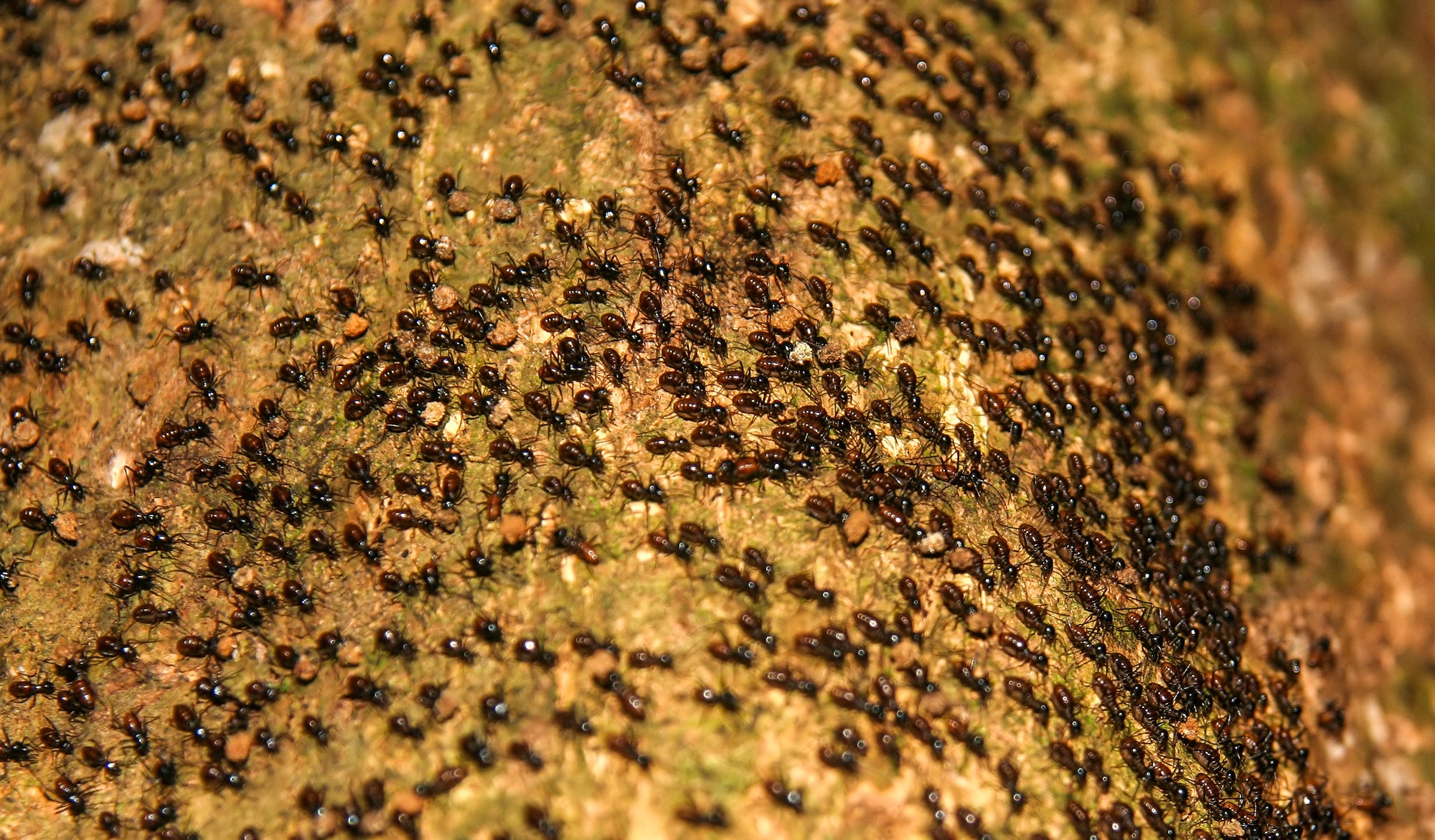
Ant colonies reproduce in two main ways: winged queens and males fly off to mate and start brand-new colonies, or a queen walks off with a group of workers and sets up a new nest nearby, which is called budding. Inside each colony, the queen does the egg-laying. The workers you see on your counter are sterile females, so squashing them doesn't slow down the part of the colony that makes more ants.
That one fact explains a lot of homeowner frustration. Here's how ant reproduction actually works, and what it means when ants keep coming back.
Who's who in an ant colony?
Most colonies have three kinds of ants:
- The queen (or queens). She's larger than the others and lays the eggs. In some species, one queen can keep a colony going for years. North Carolina State Extension says a black carpenter ant queen can live as long as 15 years.
- Workers. According to the University of California IPM program, these are sterile females. They gather food, feed and care for the larvae, build tunnels and defend the nest. They're the ants you find on the kitchen floor.
- Winged males and future queens. These are the reproductives, sometimes called swarmers or alates. A colony doesn't make them right away. UC IPM notes that it usually takes a few years before a colony starts producing them.
How do ants mate? The mating flight
For many common ants, reproduction starts with a mating flight, sometimes called a nuptial flight. When conditions are right, winged males and females leave the nest together and mate in swarms (NC State describes pavement ant swarms hanging in the air like a small cloud), and that's mostly the end of the story for the males. NC State notes that carpenter ant males die shortly after mating.
The newly mated female lands, sheds her wings and looks for a protected spot to start over. NC State's pavement ant fact sheet describes the process: she finds a suitable nook or crack, lays eggs, and the first generation of workers develops about two months later. From then on, the workers take over the chores and she focuses on laying eggs.
Timing varies by species. NC State says pavement ants swarm in June. Carpenter ants raise their swarmers in fall and hold them in the nest over winter, then release them in spring.
What is budding?
Not every ant bothers with a dramatic flight. Some of the ants most likely to trail across your kitchen have several queens per colony and spread by budding instead. A queen and a group of workers simply walk out and set up a new nest somewhere else.
- Odorous house ants have multiple queens, and UC IPM says new colonies begin in spring and summer when a mated queen crawls out of the nest with some workers to start a new one. Penn State Extension notes their colonies often hold several thousand workers with many queens.
- Argentine ant queens don't go off alone to found a colony. Workers go with them, according to UC IPM.
- Pharaoh ants bud when a colony gets too large or stressed by changes in temperature, food or water. UC IPM adds that budding may also be triggered by insecticide sprays on trailing workers.
That last point surprises people. With pharaoh ants, spraying the trail can sometimes split one colony into several instead of ending it.
How fast does an ant colony grow?
It depends a lot on the species, but carpenter ants give a useful picture. NC State's carpenter ant guide says a new colony can take up to six years to fully mature. A mature colony may hold 2,000 to 3,000 workers and produce 200 to 400 winged swarmers every year. The colony can also spread into satellite nests, where workers move out of the main nest carrying larvae and pupae with them.
So a carpenter ant problem in a wall may be connected to a parent nest outside, in a tree or stump, rather than being one self-contained nest.
Winged ants in the house: should you worry?
Seeing a few winged ants outdoors in season is normal. Winged ants inside, especially several at once near a window, deserve a closer look. University of Minnesota Extension says swarming winged ants inside a building indicate an indoor nest. It also notes that carpenter ants may swarm indoors on warm days in late winter, earlier than their usual outdoor season.
Before you assume ants, make sure they aren't termites. The same UMN guide lists three easy checks:
- Waist: ants have a pinched, narrow waist. Termites look thick through the middle.
- Antennae: ant antennae are bent at an elbow. Termite antennae are straight and beaded.
- Wings: an ant's back wings are shorter than its front wings. A termite's four wings are all the same size and much longer than its body.
Our guide to carpenter ants vs. termites goes deeper if you're still not sure. If you can catch a few, put them in a sealed bag or jar, since a physical sample is easier to identify than a blurry photo.
Why ant trails keep coming back
Put the biology together and the pattern makes sense. The ants on the counter are workers sent out for food. The queen stays tucked away in the nest, laying more eggs. As UMN puts it, the queens must be killed to eliminate a colony. Wiping out a trail just means the colony sends new workers.
Here's what helps:
- Use bait instead of spraying the trail. Slow-acting baits work with the colony's own habits. Workers carry the bait home and share it mouth to mouth with other workers, larvae and queens. Penn State recommends baits labeled for sweet-loving ants for common house-invading species like odorous house ants, and notes that slower baits don't kill the workers before they've shared the bait. Always follow the label, and place baits out of reach of kids and pets.
- Give the bait time. Ants feeding at the bait are doing the job for you, carrying it back to the nest. Leave that trail alone rather than spraying it.
- Remove the reason they came. Wipe up sweet spills, store food sealed, and fix drips under sinks. Our article on why ants show up in kitchens after rain covers the moisture and weather side.
- Follow the trail back. Watch where the ants come and go, whether that's a baseboard gap, a window frame or a slab crack. That tells you where to bait and what to seal once the activity drops.
The honest limit: if you're dealing with winged ants indoors, possible carpenter ants in wood, or a budding species that keeps popping up in new rooms after you've treated, the nest may be somewhere you can't reach. That's when an inspection usually saves time.
If you're around Nashville and the trail won't quit, Thrive's ant control team can help track down where the colony is and what will actually reach it, including in nearby areas like Franklin.
Need help beyond the article?
If the signs around your property match what you are reading, you can review the related service or call Thrive with the details you have.