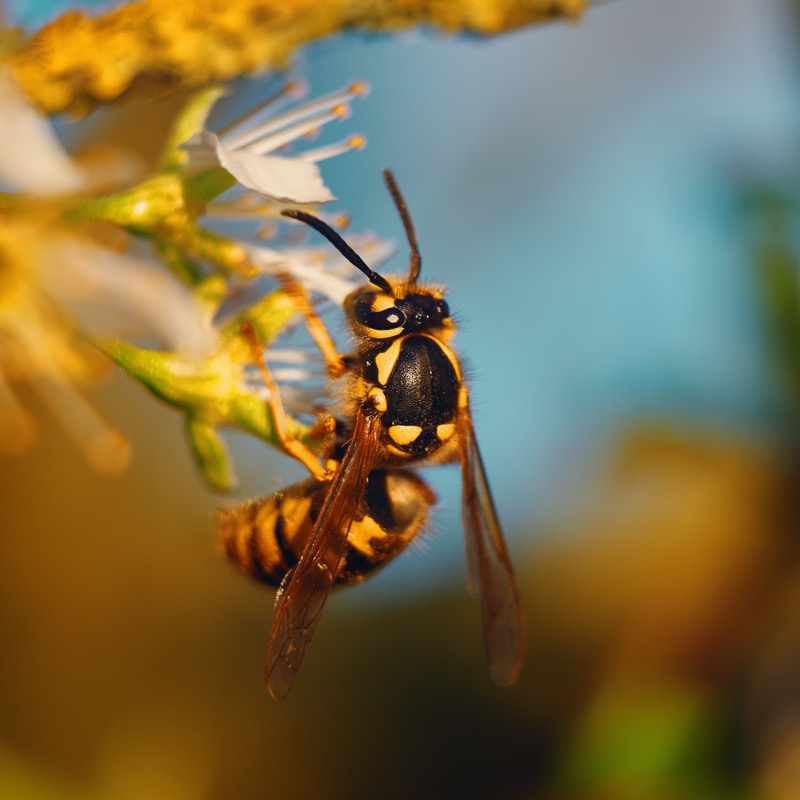
A tight ball or curtain of bees hanging from a branch is probably a honey bee swarm. A papery structure under an eave, an open comb, or steady traffic into a hole is more likely a wasp or yellow jacket nest. The safest first move is the same either way: keep your distance, bring children and pets inside, and observe from somewhere protected.
Do not spray first and identify later. Honey bees are valuable pollinators, and a swarm may move on by itself or be collected by a beekeeper. Wasps and yellow jackets can also be useful outdoors, but a nest beside a doorway, play area, or regular yard-work route may need professional attention.
What does a honey bee swarm look like?
A honey bee swarm often looks like a dense, living clump wrapped around a tree limb, fence, shrub, mailbox, or another exposed object. The main group stays clustered around the queen while scout bees search for a permanent home.
The Tennessee Department of Agriculture explains that these clusters are temporary and commonly leave within 24 to 48 hours. That does not mean you should walk up for a closer picture. Keep people and pets away, avoid vibration or mowing nearby, and contact a beekeeper if the location creates a real conflict.
What does a wasp nest look like?
There is no single wasp-nest shape. Paper wasps build exposed combs with visible open cells, often under eaves, deck rails, porch ceilings, or outdoor furniture. Bald-faced hornets build enclosed gray paper nests. Yellow jackets often use a ground hole, wall void, or another hidden cavity, so you may notice the flight path before you see any nest.
A nest has a fixed location and repeat traffic. Watch from a safe distance for insects using the same opening again and again. A swarm, by contrast, is usually an exposed mass of honey bees resting together without a finished paper nest around them.
Quick comparison: swarm or nest?
| What you see | More consistent with | Useful next step |
|---|---|---|
| A dense cluster of bees on a branch or fence | Temporary honey bee swarm | Keep back and contact a beekeeper if removal is needed |
| Open paper comb under an eave or rail | Paper wasp nest | Avoid the area and assess how close it is to normal activity |
| Gray enclosed paper structure | Hornet nest | Do not shake, strike, or spray it |
| Fast traffic into soil, siding, or a wall gap | Yellow jacket or another cavity nest | Mark the location from a distance; do not seal it |
| Bees repeatedly entering one wall opening | Established honey bee colony may be present | Get a reliable identification before choosing removal |
Color alone is a weak clue. A clear zoomed photo and a description of the structure, opening, and flight pattern are more useful than getting close enough to count stripes.
Is a bee swarm dangerous?
Swarming honey bees are generally less defensive than bees protecting an established nest, but they can still sting. The University of Minnesota Extension recommends staying back and keeping other people away from a swarm. Treat any cluster seriously when someone nearby has a known sting allergy or when the bees block a busy entrance, sidewalk, or play space.
If anyone has trouble breathing, swelling away from the sting site, dizziness, or another possible severe allergic reaction after a sting, seek emergency medical help. This article can help with the yard puzzle; it cannot replace medical care.
What should you avoid doing?
- Do not swat at the insects or throw objects at the cluster or nest.
- Do not stand in the main flight path to get a better photo.
- Do not run a mower, trimmer, or blower beside the activity.
- Do not seal an active wall or ground opening.
- Do not use a broad outdoor spray on a cluster you have not identified.
- Do not climb a ladder near active stinging insects.
The EPA's pollinator guidance emphasizes following pesticide labels and reducing pollinator exposure. Identification is part of that common-sense approach. More product is not a substitute for knowing what you are treating.
Who should you call?
For a temporary honey bee swarm, start with a local beekeeper or swarm-removal contact. Some beekeepers collect accessible swarms. Availability, access, height, and location all affect whether someone can take the cluster.
If honey bees are established inside a wall, the job is different. The Tennessee Department of Agriculture's wall-colony guidance notes that the bees and comb both need attention; simply closing the entrance can leave honey and wax inside the structure.
For an active wasp, hornet, or yellow jacket nest near people, Thrive can help you identify the likely insect and decide whether wasp nest removal in Nashville is appropriate. If you are in Williamson County, you can also review Thrive's Franklin pest-control service area. A photo taken with zoom, the nest height, and the nearest door or play area make the first conversation more useful.
A sensible next step
Look for the big distinction: a temporary exposed cluster versus a built nest or a repeatedly used opening. Keep your distance, protect the traffic area, and get an identification before anyone treats or seals anything.
If the activity is a wasp nest and it sits where people regularly pass, contact Thrive Pest Control. If it is a honey bee swarm, a beekeeper may be the better call. Either way, you do not need to settle the question by walking underneath it with your phone held overhead.
Frequently asked questions
Will a honey bee swarm leave on its own?
Often, yes. Tennessee's agriculture department says swarms commonly move within 24 to 48 hours as scout bees locate a new home. Keep the area clear while you wait, and seek help sooner when the cluster creates a safety conflict.
Should I seal the hole where yellow jackets are flying?
No. Sealing an active opening can redirect insects into the building or another exit. Leave the opening alone and point it out during an inspection.
Can Thrive remove a honey bee swarm?
Do not assume a pest-control visit and a beekeeper's swarm collection are the same service. Contact a local beekeeper first for a temporary honey bee cluster. Thrive's relevant service path is wasp and yellow jacket activity; identification comes before the plan.
Need help beyond the article?
If the signs around your property match what you are reading, you can review the related service or call Thrive with the details you have.