
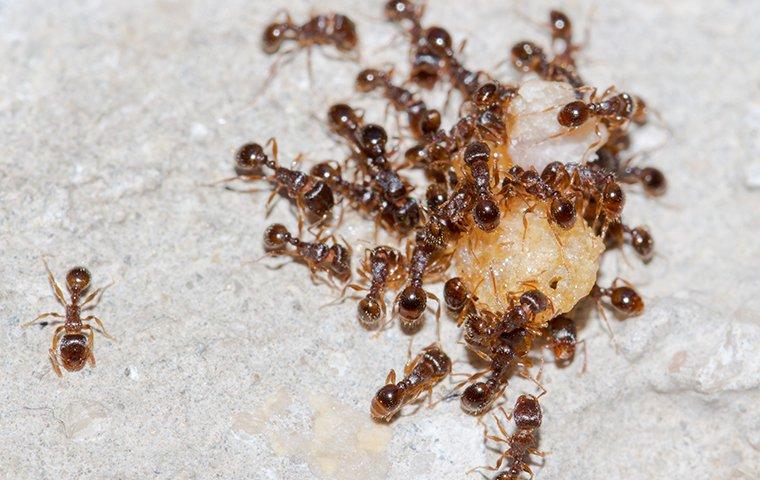
What Do Ants Eat?
It’s a beautiful, sunny day at your favorite spot in the park. You’ve packed a picnic lunch for you and your sweetie. A basket brimming with enough food to feed the both of you and a small army… of ants. As you unpack your feast, ants from a nearby hill come marching one by one to partake as well. Why are they coming for your picnic? What could they possibly want there?
Ants are omnivores, or eaters of just about everything. This is largely an evolutionary adaptation, as a worker ants main job is to return to the nest and share its food with the queen and her larvae. Ants have two stomachs- a smaller one for their individual use, and the larger of which is made for that additional food storage.
But not all ant species are created equal. Not unlike humans, ants can have favorite or preferred foods- and can be identified by their eating habits. While still omnivorous, different ant groups can have a taste towards other insects, dead and decaying animal protein, sweets, grains, foliage, fungus, and whatever else might be in your picnic basket that day.
Ants are, at heart, foragers. The sustainability of the colony depends on finding food for the queen and future workers. Further, their diets can change based on the time of year. In the spring, a colonies focus is the next generation and growing its larvae into strong new workers. For this reason, they will look for sources of food high in protein in order to sustain themselves.

What started with just a few ants invading your picnic space has now become more than you can count, seemingly out of nowhere. That’s because of the work of their chemosenses- small bristles that work on the ant as receptors to find and detect food. More efficient than calling up their ant buddies back home to come and join the picnic, ants leave a chemical trail as a scent for other ants to follow.

The scent (pheromones) allows other ants to know where the food is at and help return with it to the colony. From here, they begin to set out in shifts. Each time they return to the nest with food, they are leaving a fresh trail of pheromones behind them for other ants to follow. Ants are capable of carrying twenty times their own body weight, meaning a significant amount of food can be brought back to the nest at a time.
So, what do ants eat? The better question is- what don’t they eat? Every species is different, but ants are largely opportunists just looking for the next picnic or spill on your kitchen counter. Many people find ants in their kitchens, for obvious reasons. Keeping food in airtight containers is one way to prevent ants from seeking out their next meal, as well as cleaning up spills and leftover food immediately. A good rule of thumb is if you enjoy it, the ants will likely enjoy it too.
Author: Caitlin H.
Arizona State University
Arizona State University
What do ants eat? — Caitlin’s student essay
Arizona State University
Author: Caitlin H.

Keeton Alder At Thrive Pest Control
Hi, I'm Keeton. I've been working in the pest control industry for about 14 years. Since then, I have seen some pretty intense pest infestations and have written about most of them. I currently live in Nashville, Tennessee and when I am not writing about pests, I enjoy getting outside and exploring the beautiful Tennessee landscapes.